




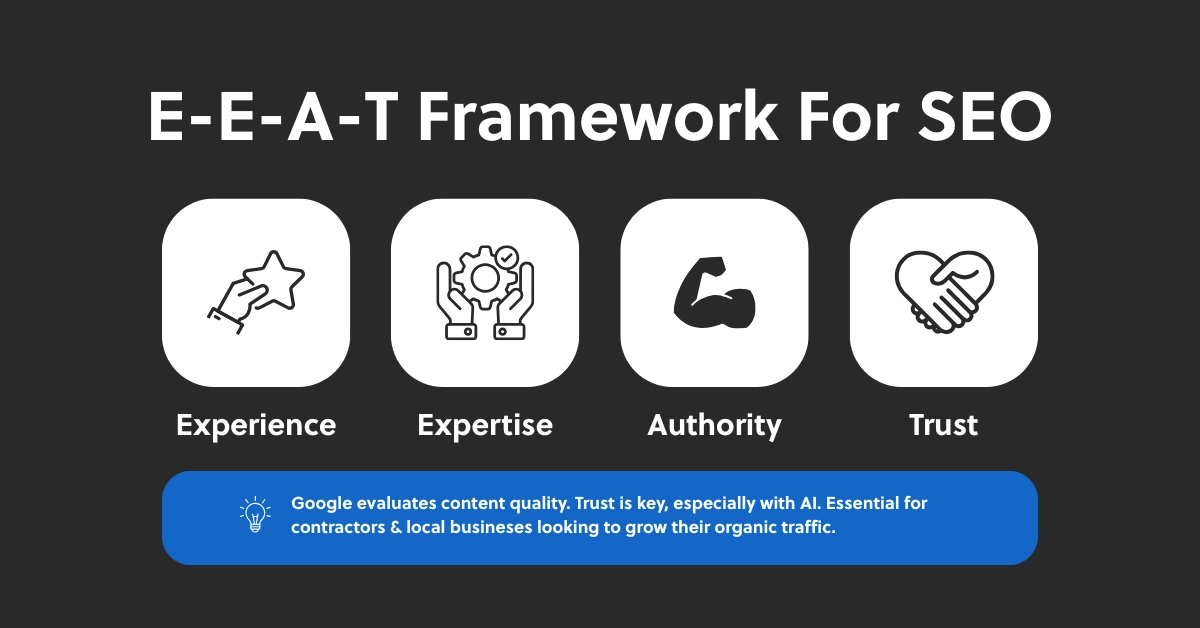
E-E-A-T stands for Experience, Expertise, Authoritativeness, and Trustworthiness. It's a framework that Google uses to evaluate the overall quality and credibility of your website content.
It's outlined in Google's Search Quality Rater Guidelines, which is basically the playbook that human quality raters use when they're evaluating search results.
Out of the four principles, trustworthiness sits at the core and carries the most weight, especially in today's world with AI (we’ll talk about it more).
If you're a roofer, contractor, a local service business, or really any business investing in SEO, understanding E-E-A-T is a must for any content writer.
How to Apply E-E-A-T for SEO
Here's the thing most people miss. E-E-A-T isn't evaluated on a page by page basis. Google looks at your entire site and brand.
Your content plays a big role, but it works best when it's backed by strong author signals and trust indicators across your whole website.
1. Strengthen Author Signals in Blogs
Make it clear who's creating your content and why they're qualified to write about it. (eg. "Aaron has over 15+ years of experience installing roofs and has earned numerous roofing awards".)
Here are some ways to do that:
- Create dedicated author pages that outline background, experience, and areas of expertise
- Link every article to its corresponding author page
- Include a short author bio within each article to give readers immediate context
- Support author signals with article and author schema markup, including descriptions and relevant knowsAbout fields
These steps help reinforce accountability, expertise, and consistency across all your blog content.
2. Demonstrate Real World Experience
This one is huge. You need to show that your content is based on firsthand knowledge, not just theory.
- Write from direct experience when possible
- Use examples, explanations, or insights drawn from real and credible scenarios
- Avoid generic content that simply restates what already exists elsewhere
If you're a contractor or service based business, this is where you can really stand out. Talk about projects you've completed. Share what you learned on the job. That kind of content is something AI tools and your competitors can't replicate.
3. Publish Accurate Content
Expertise shows through depth, clarity, and accuracy.
- Go beyond surface level explanations
- Explain why something works, not just what to do
- Keep content updated as information changes
This is especially important for topics that fall under YMYL (Your Money or Your Life) categories.
Google holds those pages to a higher standard because inaccurate information can directly impact someone's well being or finances.
Building accurate content also helps with AI citations.
4. Build Authority Beyond Your Site
Authoritativeness is all about how your brand is recognized.
- Earn relevant mentions and backlinks by creating linkable assets (infographics, statistics, etc.)
- Reference credible sources when appropriate
- Maintain a consistent brand presence across platforms (be active)
A strong digital marketing strategy ties all of this together. The more your brand shows up in trusted places, the more authority you build in Google's eyes.
5. Reinforce Trust at The Site Level
Trustworthiness is the foundation of E-E-A-T and it applies to the entire user experience.
- Clearly display business information and contact details
- Maintain transparent policies and disclosures
- Use secure site infrastructure and reliable hosting
- Include reviews and testimonial videos
- Ensure pages are easy to navigate and free of deceptive elements
Think about it this way. If a homeowner lands on your site and can't find your phone number, doesn't see any reviews, or the site looks outdated, trust goes right out the back window.
And that impacts how Google sees you too. 👀
E-E-A-T in the Age of AI
Google is using E-E-A-T to separate real human value from AI noise. And there's a lot of noise right now.
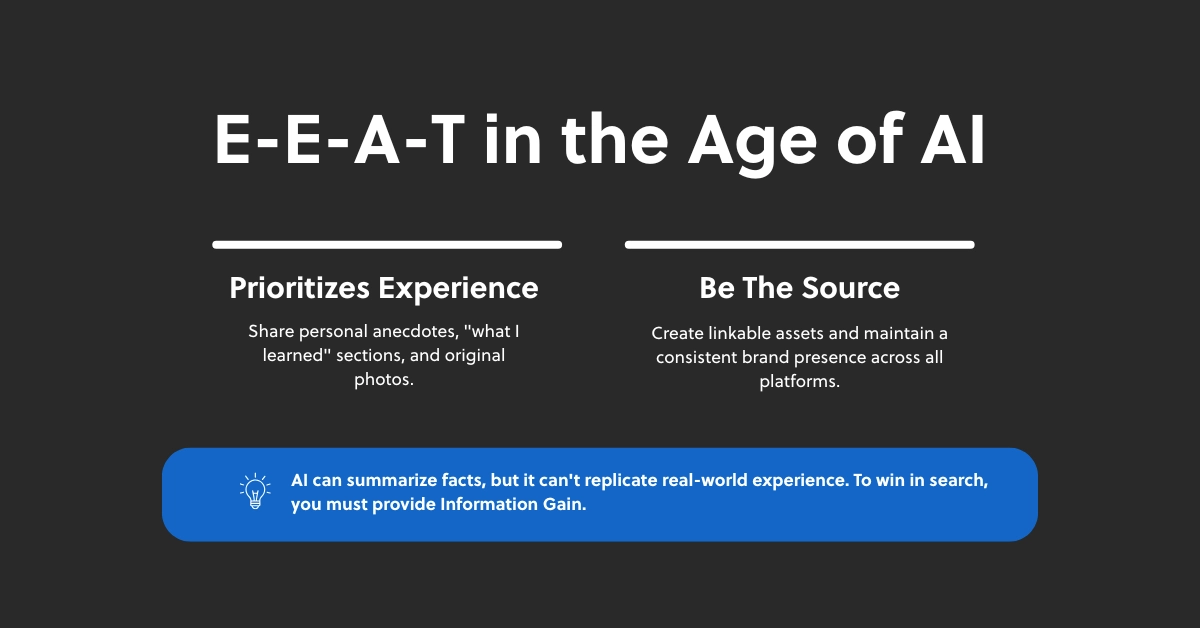
While AI can summarize facts, it can't replicate real world experience.
To rank, you need to provide what's called "Information Gain", which is value that an algorithm simply can't make up on its own at the moment.
- Prioritize Experience: Share personal anecdotes, "what I learned" sections, and original photos. AI can't actually "do" things. Showing that you did the work is your biggest advantage. It’s all about making your content unique.
- Provide Information Gain: Don't just repeat what's already online. Add unique data, case studies, and credible sources. According to Search Engine Journal, original research and first hand data are among the strongest signals for demonstrating expertise and experience.
- Human Verified Trust: Be transparent about your process. Use clear author bylines and if AI was used for research, mention it. Just make sure a human expert fact checked the final result. By the way, we did use AI to conduct research for this blog.
- Be the Source: Aim to be the original source that AI models cite. When you're the "source of truth," your authority and rankings naturally go up.
Key takeaway: AI content is everywhere now, literally. The businesses that will win in search are the ones that bring something AI can't. Real experience, real data, and a real human behind the content.

Final Thoughts
E-E-A-T may sound like just another SEO acronym or however you want to frame it, but it's one of the most important concepts to understand if you want your content to rank high on Google or really any search engine.
It's not about gaming the system. It's about proving to Google and to your potential customers that you know what you're talking about, you've done the work, and your site can be trusted.
Frequently Asked Questions
What does E-E-A-T stand for in SEO?
E-E-A-T stands for Experience, Expertise, Authoritativeness, and Trustworthiness.
Is E-E-A-T a direct Google ranking factor?
Not exactly. E-E-A-T isn't something you can toggle on or off like a light switch. It's a set of quality principles that Google's algorithms and human Quality Raters use to assess your content. Improving your E-E-A-T signals can absolutely influence how your pages perform in search though.
How do I improve E-E-A-T for my website?
Start by creating detailed author pages, writing from firsthand experience, and publishing accurate in depth content. From there, work on earning backlinks from reputable sources and making sure your site clearly displays business information, reviews, and transparent policies.
Do this on your entire site!
Why is E-E-A-T important in the age of AI content?
With AI generated content flooding the internet, Google is leaning on E-E-A-T to find content that brings real human value. AI can summarize what's already out there, but it can't replicate firsthand experience, original research, or genuine expertise.
Focusing on E-E-A-T is how you appear in AI snippets and rank above your competition.
Need Help With Contractor Marketing?
We specialize in helping home service businesses upgrade their websites, SEO, and lead generation.
.svg)